Tag Archives: life

From Intimidation to Impact: Lessons from My First Women’s Conference

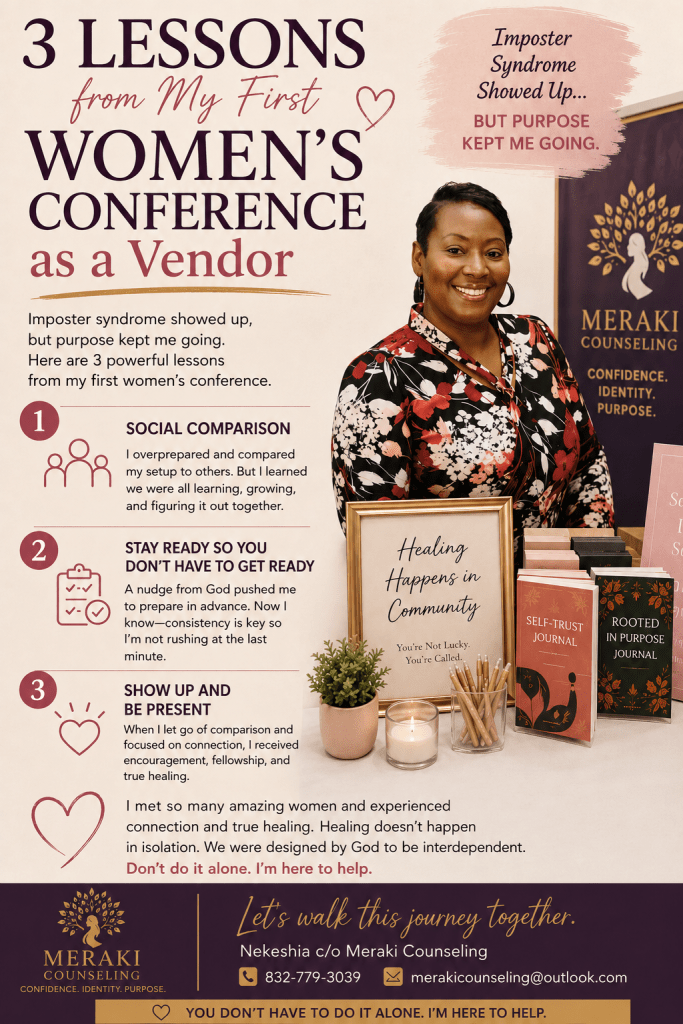
After attending my first women’s conference as a vendor, I have to tell you all about it.

To be honest, I am in a season where I am intimidated by new ventures. When the opportunity arose for me to be a vendor at The Healing Seat event, I dove in feet first. I never want to pass up an opportunity that is aligned with my niche and metron of serving women, especially women of color.

However, I want to be transparent in sharing that, after looking at the panelists’ and curator’s résumés, I was afraid. There was also a learning curve because I had never been a vendor before. I learned three lessons as I prepared for and attended the event.

1. Social Comparison

I really believed that I would be out of my element doing this event. Here is where the imposter syndrome kicked in. I overprepared. I had so much stuff, including my journals, table props, and freebies, that I could not put everything on the table.

The perfectionist kicked in, and although I know there is no such thing as perfection, I attempted to make my table perfect.

The morning I set up, I watched one lady blow up balloons and another pull out well-polished banners and books for her vendor table. Social comparison came into play when I asked the curator’s mom, “How does my table look?” and then braced myself for the critique.

I was totally surprised when she said, “It looks good.”

That day, I received so many compliments from other vendors, panelists, and attendees. I learned that this was several women’s first time as vendors, too, and they had a learning curve just as I did. There was no need to compare.

2. Stay Ready So You Don’t Have to Get Ready

I got a nudge from God to work on my businesses (I am also a genealogist) before the vendor opportunity became available. I had interest in participating in a fair in East Texas, where my maternal roots are.

I have dozens of journals and books lying dormant in files on various platforms that I have not self-published yet. I also have just as many creative ideas—bookmarks, shirts, and other paraphernalia—written in composition notebooks, waiting to get off the page and into reality.

So, I found myself doing so much during the last month leading up to the event. What I learned is that, in order to stay sane, I need to do a little bit every month so I am not ordering books, banners, and promotional items at the last minute.

3. Show Up and Be Present

If I had continued comparing myself during the event and wondering if my table was good enough, I would have missed out on some wonderful opportunities to glean from the women in the room.

There were so many moving parts and people that I could have missed the very purpose of the event—to experience faith and fellowship in a safe and healing environment.

As the panelists shared their testimonies and the attendees asked questions, I could see that my narrative and life story paralleled theirs. I learned to take a deep breath and sit back to enjoy the scenery and the gift before me—life experiences, love, and compassion.

I met so many women and networked throughout this conference. Although I did not sell as many journals as I had hoped, I experienced something much greater and priceless…connection and true healing.

Yes, I ugly cried at one point, overwhelmed with gratitude and relief after accomplishing my first event.

Healing does not happen in isolation. We were designed by God to be interdependent. As my coach and mentor, Dr. Dharius Daniels, often says, “You can’t be your best self by yourself.”

Don’t do it alone. Reach out today to Nekeshia c/o Meraki Counseling at 832-779-3039 or merakicounseling@outlook.com, and let me walk with you on your journey of self-discovery.

What If I Believed I Was Already Equipped?

I thought about the potential that lies dormant in those of us who suffer with imposter syndrome. It lies dormant because, deep down, our core beliefs keep us trapped there. The “there” is not flourishing—just surviving.

Core beliefs are centered on what we think about ourselves, other people, and the world around us. Our core beliefs begin to form from birth through early childhood. These core beliefs shape how we view the world. They are our lens.

What follows are possible core beliefs associated with imposter syndrome:

About the Self: Usually, these revolve around having a flawed identity (“I am not good enough,” “I don’t have it together”) or competency (“I am incompetent,” “I don’t have the education or knowledge needed”). If one thinks they are flawed in some way, that belief alone can keep them from even walking into the rooms where they belong because of this inaccurate belief.

About Others: Our ideas about our peers or other people often center around omniscient judges whom we feel are watching us and waiting to critique us (“They are killing it,” “People will think I am a failure”). Somehow, we think that others are focused on us and will judge us, keeping us in performance mode.

About the World: Assumptions based on skewed views of social media and the news definitely shape this area (“Now that is successful,” “Hustle until you die in order to make it”). The thing about viewing the world through this lens is that, depending on what is trendy or not, you will never be able to live up to the identity God has given you.

Now, to answer that question: What If I Believed I Was Already Equipped?

If we have a healthy and realistic view of ourselves, we would walk into those rooms with confidence. We would look at others and not be afraid to ask what the reality of a situation really is. I have been taken aback to find out the true process of other women and, especially, to discover they are just like me. If I don’t make assumptions about the world and assimilate to the status quo, it will keep me walking in my own purpose and aligned with what God assigned to me. We would walk boldly in our callings.

If this post resonated with you in any way, I want to hear from you. Call Nekeshia c/o Meraki Counseling at 832-779-3039 or email merakicounseling@outlook.com.

Remember, and say it with me:

“I AM EQUIPPED!”

From Surviving to Thriving: Replacing Hustle with Alignment

On my personal journey, I realized something. That something is that I had a hustle mindset. It came from years of overworking to get to where I wanted to be. I adopted the ideology, “I’ll sleep when I die,” like so many other Americans. I didn’t realize I was caught in a chronic pattern of hustle followed by burnout.

I don’t want you to go down the same path, so I’m sharing three shifts to help you move from surviving to thriving by entering alignment mode.


Recognize the Survival Pattern

When you are in survival mode, it is nearly impossible to reach higher-level needs and achievements. Survival mode focuses on basic needs—sleep, water, food, and shelter. This concept comes from Abraham Maslow’s Hierarchy of Needs. Maslow proposed that one cannot reach the top of the pyramid—self-actualization (living in your full potential, growing your talents, and experiencing true fulfillment)—without first stabilizing foundational needs.

In other words, if I am constantly worrying about safety or where I’m going to lay my head, reaching my full potential will likely remain out of reach. Similarly, if I am living in fear of being exposed as “a fraud,” my focus shifts to proving myself rather than purposefully growing.

Identify where your hustle has been driven by fear, imposter syndrome, or the need to prove yourself rather than by purpose.


Realign with Your Values and Calling

Alignment begins with understanding your motivation. My mentor, Dr. Dharius Daniels, often says, “Willpower fades, but why power fuels real change—if your why doesn’t make you cry, the price of commitment will always be too high.”

Wanting to achieve a goal is not enough to sustain you through the process. Your why is the fuel that drives the car of success. You must be cognizant of your purpose, passions, and values.

Clarify your why. Reconnect with your strengths. Shift from a performance-based identity to purpose-based living.


Create Sustainable Rhythms for Thriving

Now that we’ve identified survival patterns and clarified our why, we can determine what behaviors need to be implemented to shift from surviving to thriving.

I read The Compound Effect by Darren Hardy, and it remains one of the most impactful books I’ve read in my 50 years. Its core message reinforced a powerful truth: big change comes from small, consistent actions over time. Life is a marathon, not a sprint.

Replace burnout cycles with intentional boundaries, supportive community, and consistent, aligned action steps.

If you’re ready to move from survival mode to a life of clarity, confidence, and alignment, you don’t have to do it alone. Let’s begin the work together. Visit me-raki-counseling.com to schedule a consultation or learn more about working with me at Meraki Counseling. Your thriving season starts with one intentional step.