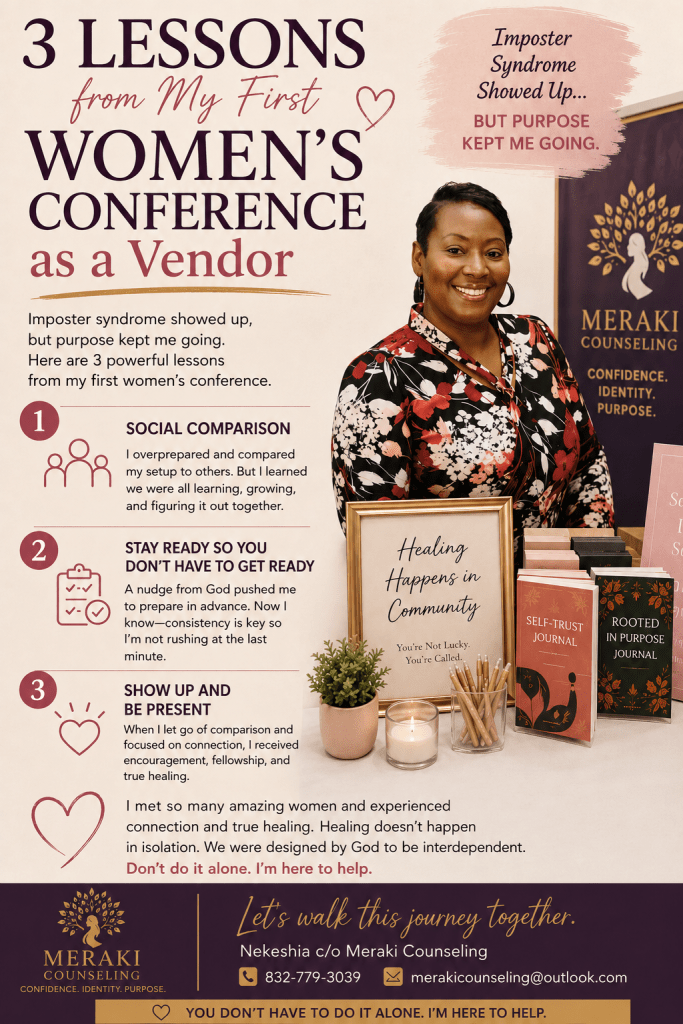
Feeling like an imposter can indeed seep into various facets of life, including your social interactions. Recently, I have experienced the ugly manifestation of imposter syndrome while trying to revamp my social life. For so many years, I have experienced success and wins while raising children, completing college, and starting a career and business through my counseling practice. I have published books and journals, yet I still feel unaccomplished in my personal life.
Recently, after participating in a challenge that one of my dear coaches, Shalonda Allison, started called “Stop Preparing, Start Producing,” I gained some insight about myself. Although I show up confident and competent in some areas, like my career and education, I avoid visibility when it comes to my personal life.
I don’t know how many times I have turned down social engagements due to not feeling equipped or ready to engage with others outside of the work world. Avoiding being seen and feeling like you don’t measure up to others will have you sitting on the couch all weekend when you could be out meeting, networking, and socializing with some good people.
This challenge has motivated me to quit preparing by paying for courses and buying books (mind you, I could start a small bookstore with the number of books I have on interpersonal skills and relationships). The truth is, I don’t need another course, coach, or book to give me permission or the confidence to get out and start living life.
If this post resonates with you in some form or fashion, don’t hesitate to reach out for support. Contact Nekeshia Limuel c/o Meraki Counseling at 832-779-3039 or merakicounseling@outlook.com today.
Have you ever wondered why you feel stuck or paralyzed while dealing with Imposter Syndrome? If you have been following this page for a while, you probably have seen yourself throughout the posts.
Something that I have seen in the lives of so many of my clients is being paralyzed, which keeps them from achieving their goals and living a life that is flourishing. Heck, I’ve even seen this in myself over decades. I started working with a coach, Shalonda Allison, who helped me realize something. The concept that Coach Shalonda revealed to me was the perfect procrastinator. Let me tell you how it shows up in high achievers, specifically myself.
I have a pattern of starting projects but not executing. Why, you may ask? The answer is simple and plain. Something deep inside of me says, “It’s not ready yet. It needs a few more tweaks.” Or I may tell myself, when it comes to building my social life and circle, “I’m not ready to be in a relationship.” This would lead to discounting the hours of education, training, and life experiences I have from 50 years of living.
The truth is I am, and every project I have started is ready to go, but I believe the voices of Imposter Syndrome over being prepared to launch and go. After becoming aware of my patterns through coaching, I made a commitment to myself that I would not start “nan” other project without executing and finishing the plethora of projects living rent-free in my space. Mind you, I have decades of notes in composition notebooks, outlines and book covers for books, and AI chats of formats for groups and programs that would increase and diversify my income.
I have also committed socially to engage with others in an intentional way. No more sitting on my couch watching Netflix when I have been invited to get out and socialize. I even took this commitment a step further by not waiting on anyone to invite me out to socialize. I will create opportunities to realize my goals.
I share my story in an effort for you to see what imposter syndrome looks like in real time. I am a work in progress, and I will continue to do the work so I can be the best counselor and coach delivering services to you. I pray that this article blesses you and helps you realize you do not have to journey alone on this road of self-discovery and overcoming Imposter Syndrome.
Contact me, Nekeshia c/o Meraki Counseling, today at 832-779-3039 or merakicounseling@outlook.com. A thriving life awaits you.
Let’s get to the bottom of this. Too many of my sisters are suffering with imposter syndrome and believing lies over truth. To help you uncover some deep-rooted beliefs about yourself, here are a few questions to ask yourself:
Do you often feel like you don’t belong in certain spaces, even when you’ve earned your place?
Do you attribute your success more to luck than to your abilities or effort?
Do you feel like others overestimate your competence?
Do you worry that people will “find out” you’re not as capable as they think?
If you can answer yes to these questions, you are living with imposter syndrome or identity issues. You do not see yourself the way that God sees you—and that is a major problem.
God sees you as fit and made to be in the very spaces you are questioning you belong in. In fact, you are divinely and uniquely made for those rooms and tables. Your life history, your pain, and your passion say that you are the missing piece of the puzzle to solve the problem only you can fix.
Your success and accolades are not happenstance or serendipity—that is divine. God has ordained and gifted you with talents, gifts, and a unique makeup that, when combined, is powerful.
Don’t discount the competency and knowledge people see in you. Stop brushing off those compliments about how well you presented or what you created. It is not an overestimation—it is truth.
You are not a fraud, so you don’t have to worry about being found out. You are fully capable and equipped to take on that task, write that book, and start that business. Yes, you are capable of being a good mom and wife, so don’t doubt yourself.
Now is the time to begin the work of peeling back the layers of underlying beliefs that contribute to imposter syndrome. Don’t tarry. Call Nekeshia c/o Meraki Counseling today at 832-779-3039 or email merakicounseling@outlook.com.
Last month, we looked at information pertaining to dimming one’s light. We identified underlying causes like invisibility syndrome, safety, and survival—and what it looks like when we dim our light. Now, we will look at owning your presence confidently—you know the true you.
Trust your voice—stop filtering your thoughts before you speak
You know exactly what to say. You raised your hand in the Zoom call but put it down before anyone could notice. You must trust your voice and value it. Get comfortable with speaking. Don’t stay stuck in your head, filtering your thoughts over and over. Write down the main point you want to get across and execute—say it.
Take up space without apologizing for it
You deserve to be in the room and/or at that table. Walk in unapologetically and take up space. You add value to the spaces you enter. You are knowledgeable and offer a light and unique perspective that only you can add.
Stand confidently in your knowledge, skills, and lived experience
You don’t need another degree. The skills and competence you have gained over the years are an asset to the people you come in contact with. Not only have you been educated and worked on building skills, you also have lived experiences of love, pain, and practicality that only you can confidently share with others.
Express your authentic self without shrinking to fit others’ expectations
I know you feel like you have to hide your true self. You think others will see you as weird or expect you to fit in. Let the world see that seemingly odd behavior. Your authenticity will make way for others to be their authentic selves.
Own your wins—big and small—without downplaying them
Own and acknowledge your wins. Stop deflecting your progress. When you own your wins, it helps you maintain momentum. Track your accomplishments in a journal, reward yourself for milestones, and share your progress with a supportive network.
Your next steps
If this resonates with you, don’t just read it—apply it. Choose one area this week to show up differently. Speak up. Take up space. Acknowledge your win. Your light was never meant to be hidden—it’s time to walk in it. Reach out to Nekeshia c/o Meraki Counseling at 832-779-3039 or merakicounseling@outlook.com today.
Last week you learned that dimming your light is a safety and survival mechanism to avoid being a perceived threat amongst your peers. Do you know what it looks like to dim your light, practically?
Here are 4 tell-tale signs you may be dimming your light:
• Constantly second-guessing your thoughts, actions, and abilities • Holding back your ideas or opinions at work or in social settings • Suppressing your authentic self to fit in or be accepted • Downplaying your achievements instead of owning them
If you speak in an apologetic tone or consistently say “I don’t know,” it sounds like you are second-guessing yourself. You question why you have certain thoughts, especially if they are not the status quo or groupthink. You ruminate over your actions, doubting whether it was the right behavior. You question if you have what it takes to operate competently in your abilities.
Maybe you don’t second-guess, but you hold back your ideas and thoughts—whether professionally or personally. And I know it’s not for a lack of bright and brilliant ideas. You have to be nudged to state your opinion on different subject matter that you are an expert in.
Or do you dim your light by not showing up authentically and being true to yourself? You fear that you won’t fit in or be accepted, so you deny your glow—your quirkiness. You wear a mask that hides who you truly are.
Lastly, you downplay or avoid talking about your wins. You don’t share the journal you created or the frameworks you developed to serve your population. The promotion at work or getting engaged doesn’t get talked about like it should.
If you see yourself in any of these tell-tale signs, you’re not alone—and you don’t have to keep dimming your light. Get ready to show up fully, own your voice, and walk confidently in who you are, let’s work together.
Contact Nekeshia c/o Meraki Counseling at 832-779-3039 or merakicounseling@outlook.com today so that your light will begin to illuminate the world.
Did you know that most people choose to dim their lights out of safety and as a survival mechanism? It is, in fact, a coping strategy to not outshine one’s peers. We don’t want to appear as a threat, so we don’t answer even when we know the answer. We decline opportunities that would put us in the spotlight. Certain environments have to be navigated cautiously so as not to allow success to be put under the microscope. Instead, many individuals adopt the art of blending in, mastering the delicate balance of standing out just enough to be recognized but not so much as to invite scrutiny or envy. This behavior often stems from a deep-seated desire to belong and maintain harmony within a group.
However, it’s important to remember that embracing one’s full potential and shining brightly doesn’t necessarily mean overshadowing others. In fact, when we allow ourselves to excel and share our talents, we can inspire and uplift those around us. By fostering an environment of mutual support and celebration of each other’s successes, we create a culture where everyone feels empowered to shine in their unique way.
It becomes crucial to cultivate spaces where authenticity is valued and where individuals feel safe to express their true capabilities without fear of judgment. By doing so, we not only enrich our own lives but also contribute positively to the communities we are part of, encouraging a collective rise towards greater achievements and fulfillment.
Ultimately, by embracing our full potential and supporting others to do the same, we contribute to a world that thrives on collective brilliance. It’s a reminder that, like stars in the night sky, we shine brightest when we illuminate each other.
Call Nekeshia c/o Meraki Counseling today. The world awaits your gifts, talents and your answer to others.
While working on this post looking at the theme of Imposter Syndrome and women dimming their light I ran across a concept called Invisibility Syndrome. Invisibility Syndrome is the feeling of being overlooked, unseen, or undervalued—even when you are capable and present.
Now what does this new concept have to do with Imposter Syndrome? When someone experiences Invisibility Syndrome, they may begin to question whether their voice or presence truly matters. This can lead to Imposter Syndrome, where they doubt their qualifications or ability to contribute meaningfully.
At the same time, someone struggling with Imposter Syndrome may unintentionally make themselves less visible. They may: Stay quiet to avoid scrutiny; Hold back their ideas in meetings; Downplay their accomplishments; and Avoid leadership opportunities.
The Result: Dimming Your Light
When both patterns operate together, a person may begin to dim their light—shrinking their presence, muting their voice, and minimizing their talents to avoid attention or potential criticism. What follows are several key reason why women dim their light:
1. Fear of Being “Found Out”
A core feature of imposter syndrome is the belief that one is not as successful or competent as they think they are. These women see themselves as a fraud and live with the fear their cover will be blown so they live off grid and make no waves in the water.
2. Perfectionism and Fear of Failure
Many women with imposter syndrome feel they must be flawless in order to justify their position. They set the bar so high that it is impossible to reach. It’s like setting yourself up to fail. These unrealistic expectation to not fail keeps them from stepping outside of the status quo. Definitely would not want others to see me fall on my face.
3. Minimizing Attention to Avoid Judgment
Being visible can bring scrutiny, feedback, or criticism. Women struggling with imposter syndrome may believe that staying quiet, blending in, or minimizing their achievements will protect them from negative evaluation. The inner critic is already running a muck so wouldn’t want any external critiques or judgment.
4. Internalized Messages and Past Experiences
Women who suffer with imposter syndrome are not just living with their own thoughts of incompetence but with their history. From the time we come into this world we are conditioned. Whether we get a message or directive from parents, older siblings, teachers or classmates we begin to believe what others say. Over time, we begin to internalize the idea that it is safer to remain small than to stand fully in their abilities.
5. Difficulty Owning Achievements
Women dim their light due to struggling to accept their accomplishments, they may avoid highlighting them and instead downplay their strengths. I have lived through owning my achievements. I do things like write books, get certifications and accomplish my goals quietly. I have been told that I can not take a compliment also.
If you find yourself struggling with self-doubt, imposter syndrome, or the habit of dimming your light, you don’t have to navigate that journey alone. Meraki Counseling is here to support you as you build confidence, challenge limiting beliefs, and step fully into your authentic self.
Take the next step toward clarity and confidence today.
Before stepping into a new month, it’s important to pause and reflect on what the previous season has taught us. March offered opportunities to examine our confidence, confront imposter syndrome, and recognize the limiting beliefs that may have been quietly shaping our decisions. Reflection allows us to gather the lessons, acknowledge our growth, and intentionally release the thoughts and habits that no longer serve us. As we prepare to enter April—where we will focus on the ways women dim their light—take a moment to consider what insights, victories, and mindset shifts you want to carry forward into your next breakthrough.
Reflection Questions: Closing March & Preparing for April
1. Reflect on What You Learned About Yourself
What post or concept from this month resonated with you the most?
When did you notice imposter syndrome showing up in your thoughts or actions?
What is one insight you gained about your identity, purpose, or confidence?
2. Identify the Beliefs You Need to Release
Which limiting belief from this month do you recognize in your own thinking?
When do you tend to minimize your achievements or doubt your voice?
What narrative are you ready to let go of before entering the new month?
3. Recognize the Wins You May Have Overlooked
What small victories did you experience this month that deserve acknowledgment?
When did you show courage, even if it felt uncomfortable?
How have you grown mentally, emotionally, or spiritually over the last few weeks?
4. Prepare to Stop Dimming Your Light
In what environments do you tend to shrink or silence yourself?
What fears or expectations cause you to hold back your authentic self?
What would it look like for you to show up fully and confidently in the spaces you occupy?
5. Set Your Intention for April
What area of your life deserves more boldness and visibility?
How will you challenge the inner critic when it tells you to stay small?
What commitment can you make to yourself about showing up differently this month?
As you reflect on the lessons from March and prepare for your breakthrough in April, remember—you don’t have to navigate this journey alone. If imposter syndrome or self-doubt has been dimming your light, support is available.
Visit www.me-raki-counseling.com to learn more about working with Nekeshia at Meraki Counseling, or reach out directly to begin your journey toward confidence and clarity.
During the spring season, it is a tradition to deep clean your home after it has been closed up during the winter months. However, spring cleaning is not just for your physical space—it’s also for your mental space. Here are four common limiting beliefs connected to imposter syndrome, especially among high-achieving individuals and helpers:
1. “I don’t really belong here.”
This belief convinces women that their success is accidental or temporary. Sitting among your peers can create an inner dialogue that judges where you are in life compared to where other women are seemingly in life. The truth is that most women are not doing significantly more or less than you are in terms of achievements. You have just as much of a right to be in that room or at that table as your peers.
2. “If people really knew me, they would realize I’m not good enough.”
This is the classic fear of being “found out.” Individuals feel secretly inadequate and worry that their perceived competence is a mistake others will eventually discover. This fear can keep you staying out of the way in an effort to remain below the radar. It mutes your voice and dims the light of your authentic self when you live with this fear.
3. “I have to be perfect to be respected.”
Perfectionism becomes a coping mechanism for self-doubt. Instead of allowing room for mistakes or growth, a person believes their value is tied to flawless performance. A principle I often share with my clients is that perfection doesn’t exist. You can place perfectionism in the same closet as mythical creatures like unicorns and mermaids. When you have given your best effort, you are already winning. Waiting for perfection often leads to unfinished assignments. I would rather see completion than so-called perfection.
4. “My achievements don’t count.”
People with imposter syndrome often minimize their accomplishments. Success is attributed to luck, timing, or other people’s help rather than their own ability, effort, or preparation. The reality is that you are talented and gifted. Don’t discount your accomplishments. During Black History Month, I like to highlight lesser-known local figures who were pioneers in their communities—such as midwives who facilitated hundreds of births. The absence of letters behind a woman’s name does not make her story any less honorable.
Now that we’ve identified what needs to be tossed out—these limiting beliefs—let’s focus on affirming beliefs that can replace those old, worn-out thought patterns. Here are four affirmations designed to counter the limiting beliefs associated with imposter syndrome:
1. Limiting Belief: “I don’t really belong here.”
Affirmation: I belong in every room my preparation, purpose, and calling have led me to.
2. Limiting Belief: “If people really knew me, they would realize I’m not good enough.”
Affirmation: I am competent, capable, and continually growing. My authenticity is my strength.
3. Limiting Belief: “I have to be perfect to be respected.”
Affirmation: My value is not determined by perfection. I am worthy, even as I learn and grow.
Affirmation: My accomplishments reflect my effort, resilience, and ability. I honor my progress and celebrate my wins.
If imposter syndrome or self-doubt continues to hold you back, you don’t have to face it alone. Meraki Counseling is here to help you silence the inner critic and walk confidently in your purpose. Learn more or schedule a consultation at 832-779-3039 or merakicounseling@outlook.com.
There are several biblical examples of women who doubted themselves but were chosen anyway. These women’s stories often begin with doubt and low self-worth—so much so that divine encounters felt out of place.
The Samaritan Woman (John 4): Burdened by the reputation of five failed marriages and social ostracization, she likely felt unworthy and lived in shame. Jesus broke social norms to speak with her, revealing Himself as the Messiah and transforming her into the first missionary to Samaria. Despite being viewed through a negative lens, this woman was chosen to do something that had never been done before. It took courage to push through the familiarity people had with her past and still make a difference through missionary work. What parts of your past keep you embarrassed or make you doubt that you can be useful?
Rahab (Joshua 2): As a prostitute in Jericho, she was likely seen as irredeemable by society. Despite her background, she was chosen to protect the Israelite spies and became part of the lineage of Jesus. Prostitution is one of the oldest professions on earth, and emphasis is often placed on the woman selling her body, with the acts viewed as despicable. However, God still saw Rahab as useful and precious. Most people have skeletons in their closets that prevent them from stepping into what they are called to do. What parts of your past give you pause about doing something big in your present or future?
Leah (Genesis 29–30): Unloved and rejected by her husband, Jacob, Leah felt despised. She turned to God in her brokenness, and He honored her by making her the matriarch of the tribes of Levi (the priestly line) and Judah (the kingly line). This speaks to the woman who feels insignificant to the people closest to her—the ones who should cherish her most. Rejection can breed doubt in a woman’s capabilities and make her feel unworthy. Yet God often uses the overlooked and unloved to propel generations forward. Do you feel rejected by family, and is that causing you to doubt your ability to achieve your goals?
The Woman with the Issue of Blood (Mark 5): Labeled “unclean” for twelve years, she was an outcast who likely doubted whether she even deserved to be in public. She approached Jesus with fear and trembling, yet He called her “Daughter” and healed her. Even though society labeled her as dirty because of her health condition, she was beloved by Jesus. It took courage for her to focus not on the crowd but on the source of her healing. Your identity does not lie in society. Are you letting society dictate your identity, or do you see yourself as God sees you?
Mary, Mother of Jesus (Luke 1): A young, poor, and uneducated girl from a disregarded town, Mary likely felt insignificant in the eyes of society. Yet she was chosen to bear the Son of God. This reminds me of women who come from humble beginnings. Countless women have lived in poverty or faced tragedy, only to emerge triumphant through perseverance. They often feel overlooked not only by society but sometimes by family and friends as well. What have you been chosen to carry or create, yet feel unqualified or insignificant to do?
Hannah (1 Samuel 1): Consumed by grief and feelings of worthlessness due to infertility, Hannah described herself as one who had “poured out [her] soul before the Lord.” God heard her prayer and used her to bring forth Samuel, one of Israel’s greatest prophets. Hannah’s story reminds us that we are all created to fulfill a purpose and to be fruitful. Sometimes we give birth—figuratively—to solutions for the problems we see in society. What problem have you been called to solve?
These stories highlight that God often chooses those who feel unqualified, using their brokenness or insecurity to demonstrate His strength and grace. After answering these questions, I hope you are able to choose faith over the feeling of being a fraud. You deserve to be in that room—and you were created to shift that room.
Begin the journey of choosing faith over fraud today. Nekeshia at Meraki Counseling can help you make that shift.