Category Archives: Uncategorized

Your Next Breakthrough Isn’t a Better Mindset—It’s Better People

During this quarter, we are going to switch things up a little. Over the past year or so, the focus has been on imposter syndrome. Well, now we will venture into another area of focus that is just as consequential outside of believing in yourself—your community.

I have learned how valuable community is in living a successful life. As my mentor and coach says very often, “You cannot be your best self by yourself.” Not one lie told!

The reason that I have been able to write—not only this blog, but in different areas—and fulfill my dreams lately is because God has granted me favor in meeting people who, in some form or fashion, have helped support me.

There are certain roles that have been instrumental in helping me change the trajectory of my life. Those seven roles are:

Peer – Someone who grows alongside you, shares the journey, and sharpens you through mutual support.

Mentor – Someone who has gone before you and offers wisdom, guidance, and perspective for your next steps.

Cheerleader – Someone who believes in you, celebrates your wins, and reminds you of your strengths when you forget.

Accountability Partner – Someone who lovingly challenges you to honor your commitments and become your best self.

Values Twin – Someone whose character and core values align with yours, helping you stay true to your purpose.

Wellness Partner – Someone who encourages you to care for your mind, body, and spirit so you can thrive.

Leisure Companion – Someone who reminds you to laugh, rest, play, and enjoy the journey of life.

As you read, don’t be disheartened if there are gaps in your essential community members, or what I call your Life Board members. I found that I had a lot of gaps, but I am now reassured because I have a framework to be intentional about building my Life Board.

If you are interested in creating the kind of community that will help you finish these last two quarters of the year successfully, call Nekeshia Limuel, LPC at 832-779-3039 or email merakicounseling@outlook.com. I look forward to hearing from you.

Beyond the Degree: Overcoming the Expert Trap of Imposter Syndrome

I was thinking about a conversation I had with someone near and dear to my heart—a family member who is truly gifted at interior decorating. We talked about her use of AI on the job she has been on for 18 years, and how she feels under-equipped or believes she needs another degree to do what she is already naturally doing-visualizing and creating aesthetically pleasing home environments.

​I reminded her that she already has everything she needs, and that she needs to create a portfolio of the work she has done, not only in her own home but also on various projects she has taken on for far less than her services and creativity are worth. I told her that she fits the expert and perfectionist prototypes of imposter syndrome. The “expert” feels she needs another degree or is only competent if she has letters behind her name, which is the furthest thing from the truth.

​The women I have worked with over the years are fully competent and capable, yet they often lack the confidence, knowledge, and belief in themselves to realize they do not need another credential or degree to do what they have been naturally gifted to do.

​Key Takeaways

  • ​The Expert Prototype: This facet of imposter syndrome tricks capable people into thinking they never know “enough,” constantly chasing certifications, degrees, or more training before they feel worthy of calling themselves professionals.
  • ​The Power of a Portfolio: Documenting home projects and past underpriced work transforms intangible talent into undeniable, visual proof of true expertise.
  • ​Natural Gift vs. Formal Title: True mastery—especially in creative fields like interior decorating—comes from vision, experience, and execution, none of which require a classroom diploma to be valid.

​Take the Next Step

​Are you ready to silence your inner critic, step into your true expertise, and stop letting self-doubt undervalue your worth? You don’t have to navigate it alone. Reach out to Nekeshia c/o Meraki Counseling today at 832-779-3039 or via email at merakicounseling@outlook.com to start your journey toward confidence and clarity.

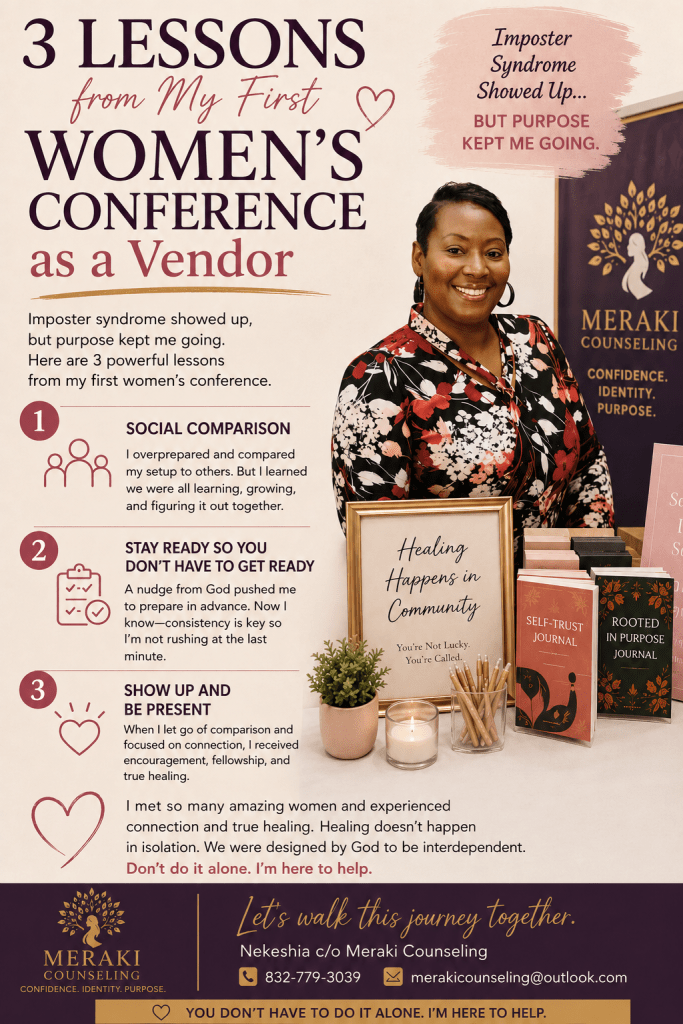
From Intimidation to Impact: Lessons from My First Women’s Conference

After attending my first women’s conference as a vendor, I have to tell you all about it.

To be honest, I am in a season where I am intimidated by new ventures. When the opportunity arose for me to be a vendor at The Healing Seat event, I dove in feet first. I never want to pass up an opportunity that is aligned with my niche and metron of serving women, especially women of color.

However, I want to be transparent in sharing that, after looking at the panelists’ and curator’s résumés, I was afraid. There was also a learning curve because I had never been a vendor before. I learned three lessons as I prepared for and attended the event.

1. Social Comparison

I really believed that I would be out of my element doing this event. Here is where the imposter syndrome kicked in. I overprepared. I had so much stuff, including my journals, table props, and freebies, that I could not put everything on the table.

The perfectionist kicked in, and although I know there is no such thing as perfection, I attempted to make my table perfect.

The morning I set up, I watched one lady blow up balloons and another pull out well-polished banners and books for her vendor table. Social comparison came into play when I asked the curator’s mom, “How does my table look?” and then braced myself for the critique.

I was totally surprised when she said, “It looks good.”

That day, I received so many compliments from other vendors, panelists, and attendees. I learned that this was several women’s first time as vendors, too, and they had a learning curve just as I did. There was no need to compare.

2. Stay Ready So You Don’t Have to Get Ready

I got a nudge from God to work on my businesses (I am also a genealogist) before the vendor opportunity became available. I had interest in participating in a fair in East Texas, where my maternal roots are.

I have dozens of journals and books lying dormant in files on various platforms that I have not self-published yet. I also have just as many creative ideas—bookmarks, shirts, and other paraphernalia—written in composition notebooks, waiting to get off the page and into reality.

So, I found myself doing so much during the last month leading up to the event. What I learned is that, in order to stay sane, I need to do a little bit every month so I am not ordering books, banners, and promotional items at the last minute.

3. Show Up and Be Present

If I had continued comparing myself during the event and wondering if my table was good enough, I would have missed out on some wonderful opportunities to glean from the women in the room.

There were so many moving parts and people that I could have missed the very purpose of the event—to experience faith and fellowship in a safe and healing environment.

As the panelists shared their testimonies and the attendees asked questions, I could see that my narrative and life story paralleled theirs. I learned to take a deep breath and sit back to enjoy the scenery and the gift before me—life experiences, love, and compassion.

I met so many women and networked throughout this conference. Although I did not sell as many journals as I had hoped, I experienced something much greater and priceless…connection and true healing.

Yes, I ugly cried at one point, overwhelmed with gratitude and relief after accomplishing my first event.

Healing does not happen in isolation. We were designed by God to be interdependent. As my coach and mentor, Dr. Dharius Daniels, often says, “You can’t be your best self by yourself.”

Don’t do it alone. Reach out today to Nekeshia c/o Meraki Counseling at 832-779-3039 or merakicounseling@outlook.com, and let me walk with you on your journey of self-discovery.

What If I Believed I Was Already Equipped?

I thought about the potential that lies dormant in those of us who suffer with imposter syndrome. It lies dormant because, deep down, our core beliefs keep us trapped there. The “there” is not flourishing—just surviving.

Core beliefs are centered on what we think about ourselves, other people, and the world around us. Our core beliefs begin to form from birth through early childhood. These core beliefs shape how we view the world. They are our lens.

What follows are possible core beliefs associated with imposter syndrome:

About the Self: Usually, these revolve around having a flawed identity (“I am not good enough,” “I don’t have it together”) or competency (“I am incompetent,” “I don’t have the education or knowledge needed”). If one thinks they are flawed in some way, that belief alone can keep them from even walking into the rooms where they belong because of this inaccurate belief.

About Others: Our ideas about our peers or other people often center around omniscient judges whom we feel are watching us and waiting to critique us (“They are killing it,” “People will think I am a failure”). Somehow, we think that others are focused on us and will judge us, keeping us in performance mode.

About the World: Assumptions based on skewed views of social media and the news definitely shape this area (“Now that is successful,” “Hustle until you die in order to make it”). The thing about viewing the world through this lens is that, depending on what is trendy or not, you will never be able to live up to the identity God has given you.

Now, to answer that question: What If I Believed I Was Already Equipped?

If we have a healthy and realistic view of ourselves, we would walk into those rooms with confidence. We would look at others and not be afraid to ask what the reality of a situation really is. I have been taken aback to find out the true process of other women and, especially, to discover they are just like me. If I don’t make assumptions about the world and assimilate to the status quo, it will keep me walking in my own purpose and aligned with what God assigned to me. We would walk boldly in our callings.

If this post resonated with you in any way, I want to hear from you. Call Nekeshia c/o Meraki Counseling at 832-779-3039 or email merakicounseling@outlook.com.

Remember, and say it with me:

“I AM EQUIPPED!”

Imposter Syndrome Unfolded in Real Time

As I prepare to embark upon a new adventure as a vendor at a women’s conference, it has become evident how imposter syndrome creeps up behind you.

The perfectionist type has definitely been my shadow for the last few weeks since I signed up to be a vendor. To be candid, I really just thought about attending the event, The Healing Seat, in July. Never did I imagine being a vendor.

I searched Pinterest and YouTube for suggestions for vendors at fairs and trade shows. I even asked ChatGPT to do a mockup image for my table setup. Many trips back and forth to stores and playing with designs on Canva have become a habit for me as I prepare.

I had to stop myself after setting up my table at home, rearranging items on the table, packing everything up, only to bring it back out again to make sure I had the best setup. Not to mention, I broke a glass item that I got from an antique shop in East Texas that is not readily available.

What this experience has taught me is that I, too, suffer with imposter syndrome. The second-guessing and overpreparing were the symptoms that became prevalent while getting ready. I had to take a step back—literally—after stepping on glass that would not have broken if I hadn’t been ruminating over a polished and perfect table that would invite and attract women to my corner.

I had to speak to myself the same way I speak to my clients:

You’ve got this.

You deserve to be in the room.

You were built for this.

This is your calling.

You are talented.

If you have discovered that nasty monster of imposter syndrome lurking in the background, don’t fight it alone. Reach out to Meraki Counseling today for assistance in building your confidence.

Imposter Syndrome and Parenting

When Good Parents Doubt Themselves

Introduction

Being a parent can be both rewarding and challenging. For those of us who experience imposter syndrome, just know it does not stop in the career realm but shows up where you lay your head—the home. This article will show you how it manifests in your world of parenting.

1. The Comparison Trap

It is very common to play the comparison game. We compare our bodies, success levels, and material possessions, but it does not stop there. We compare how our children are doing in school and whether they are reaching milestones. Imposter syndrome creeps in even more often now with the introduction of social media. We no longer have to wait on a letter or phone call to hear a parent dote on their child. The trap comes from looking at a reel versus what is real about other people’s children.

2. The Pressure to Be a Perfect Parent

One of the main types of imposter syndrome is the perfectionist. In the workplace, this manifests as overproducing and making sure that every project or presentation is flawless. Some parents try not to make the same mistakes their parents made, while others set their parenting bar so high that a giraffe couldn’t reach it.

I recall reading many books on parenting before I had my first child. Nothing could have ever prepared me for my child, nor the fact that I am an imperfect human being doing the best I can to raise another imperfect human being.

3. When Your Child’s Behavior Feels Like a Reflection of You

Then there is the weight of carrying what your children do—or don’t do—as a reflection of who you are as a parent. If they fail an assignment, we feel guilty because we had to work late. We lose our minds if our children get into trouble and feel ashamed. We often have a hard time separating our children’s actions from our role as parents.

If imposter syndrome is showing up in your parenting and creating feelings of shame, guilt, or failure, please don’t settle for feelings of ineptness. Give Nekeshia c/o Meraki Counseling a call at 832-779-3039 or send an email at merakicounseling@gmail.com so we can collaborate on ways to stop imposter syndrome from entering your parenting journey.

Imposter Syndrome in the Context of Dating

Common Signs

Hyper-focus on flaws: Being able to point out all of your character and physical flaws is common when navigating the dating scene. We definitely don’t want potential mates to find out about our imperfections because they won’t want to deal with us.

Expecting the worst: It is a trick of the mind to brace for potential bad outcomes, especially after kissing so many frogs. Some people have experienced catfishing to the extreme of becoming involved with someone who is living a double life. Now, with the internet, we can see the worst examples from all across the world.

Attributing affection to a quirk: You may feel that someone showing interest in you will eventually lose interest and that their attraction is due to luck or chance. I mean, what would a fine man like that want with a woman like me? You convince yourself that it must be a fluke rather than believing you are genuinely worthy of love and connection.

Why It Happens

Online dating pressures: Apps can pressure you to present a flawless, curated version of yourself, leading to constant comparison and feelings of inadequacy. Now add the layer of AI and photoshopped images, and you can easily hyper-focus on the areas that the opposite sex is typically drawn to.

Past trauma: Trauma trains the brain to stay on alert and anticipate threats. Depending on your experiences, things may have happened that were far outside of what you envisioned for your life. As a result, you may struggle to trust yourself.

Insecure attachment: Depending on your childhood experiences and the people who cared for you during your formative years, certain patterns can develop and carry into adulthood. Anxious and avoidant attachment styles frequently correlate with feelings of unworthiness.

Does any of the above resonate with you when it comes to dating?

If you answered yes, then you may benefit from talking with an objective professional who can help you navigate the murky waters of dating.

Contact Nekeshia Limuel at Meraki Counseling today to begin uncovering the layers of dating with imposter syndrome.

📞 832-779-3039
📧 merakicounseling@outlook.com

5 Strategies to Overcome Imposter Syndrome in Social Interactions

Acknowledge Your Feelings: The first step in overcoming imposter syndrome is to recognize and accept your feelings of self-doubt. Understand that imposter syndrome is not limited to career spaces. It can show up in your thought processes, which in turn lead you to feel incompetent and unworthy of being around others. One must identify feelings of inadequacy when it comes to building connections.

Reframe Negative Thoughts: Challenge your inner critic by reframing negative thoughts. Instead of thinking, “I’m going to feel out of place,” remind yourself that you belong in that room and at that table just as much as anyone else in that social environment. Nip that stinking thinking in the bud when it comes to building your social confidence. This shift in perspective can help strengthen your confidence in social situations.

Seek Support and Feedback: It’s important to have safe and trusted people around you who can help you step outside the social box you’ve been in for too long. Having peers, accountability partners, cheerleaders, and mentors is pivotal for increasing social interactions. In the coaching group I belong to, we have examined the Johari Window concept several times. The truth is that we all have blind spots that we cannot see, but others can see clearly. Include trusted support in your journey to overcome feeling like an imposter.

Set Realistic Goals: Break your social interactions into achievable goals. Whether it’s being intentional about engaging more socially by introducing yourself at a party or planning to attend a fun-filled painting night, your goals should be realistic and practical.

Repeat Affirmations: To drown out that inner critic mentioned in the previous point, one must have language and statements to counter the lies that you are a fraud, that you don’t fit in, or that you will eventually be found out. Tell yourself, “I do not have to earn my place in the room. My presence is enough.” To counter the idea that you have to change something about yourself to enter social spaces, say, “I trust myself to connect, contribute, and belong—even when I feel uncertain.”

Ready to stop letting imposter syndrome keep you on the sidelines of your own life?

You don’t have to navigate self-doubt, social anxiety, or feelings of inadequacy alone. If you’re tired of overthinking, avoiding opportunities to connect, or feeling like you don’t belong, support is available.

Contact Nekeshia Limuel at Meraki Counseling today to begin your journey toward greater confidence, connection, and authenticity.

📞 832-779-3039
📧 merakicounseling@outlook.com

You belong in the room. You belong at the table. And you deserve meaningful relationships and experiences. Take the first step today.

Is Imposter Syndrome Affecting Your Social Life?

Feeling like an imposter can indeed seep into various facets of life, including your social interactions. Recently, I have experienced the ugly manifestation of imposter syndrome while trying to revamp my social life. For so many years, I have experienced success and wins while raising children, completing college, and starting a career and business through my counseling practice. I have published books and journals, yet I still feel unaccomplished in my personal life.

Recently, after participating in a challenge that one of my dear coaches, Shalonda Allison, started called “Stop Preparing, Start Producing,” I gained some insight about myself. Although I show up confident and competent in some areas, like my career and education, I avoid visibility when it comes to my personal life.

I don’t know how many times I have turned down social engagements due to not feeling equipped or ready to engage with others outside of the work world. Avoiding being seen and feeling like you don’t measure up to others will have you sitting on the couch all weekend when you could be out meeting, networking, and socializing with some good people.

This challenge has motivated me to quit preparing by paying for courses and buying books (mind you, I could start a small bookstore with the number of books I have on interpersonal skills and relationships). The truth is, I don’t need another course, coach, or book to give me permission or the confidence to get out and start living life.

If this post resonates with you in some form or fashion, don’t hesitate to reach out for support. Contact Nekeshia Limuel c/o Meraki Counseling at 832-779-3039 or merakicounseling@outlook.com today.

A confident social life awaits you.

Understanding Why Imposter Syndrome Leaves You Feeling Paralyzed

Have you ever wondered why you feel stuck or paralyzed while dealing with Imposter Syndrome? If you have been following this page for a while, you probably have seen yourself throughout the posts.

Something that I have seen in the lives of so many of my clients is being paralyzed, which keeps them from achieving their goals and living a life that is flourishing. Heck, I’ve even seen this in myself over decades. I started working with a coach, Shalonda Allison, who helped me realize something. The concept that Coach Shalonda revealed to me was the perfect procrastinator. Let me tell you how it shows up in high achievers, specifically myself.

I have a pattern of starting projects but not executing. Why, you may ask? The answer is simple and plain. Something deep inside of me says, “It’s not ready yet. It needs a few more tweaks.” Or I may tell myself, when it comes to building my social life and circle, “I’m not ready to be in a relationship.” This would lead to discounting the hours of education, training, and life experiences I have from 50 years of living.

The truth is I am, and every project I have started is ready to go, but I believe the voices of Imposter Syndrome over being prepared to launch and go. After becoming aware of my patterns through coaching, I made a commitment to myself that I would not start “nan” other project without executing and finishing the plethora of projects living rent-free in my space. Mind you, I have decades of notes in composition notebooks, outlines and book covers for books, and AI chats of formats for groups and programs that would increase and diversify my income.

I have also committed socially to engage with others in an intentional way. No more sitting on my couch watching Netflix when I have been invited to get out and socialize. I even took this commitment a step further by not waiting on anyone to invite me out to socialize. I will create opportunities to realize my goals.

I share my story in an effort for you to see what imposter syndrome looks like in real time. I am a work in progress, and I will continue to do the work so I can be the best counselor and coach delivering services to you. I pray that this article blesses you and helps you realize you do not have to journey alone on this road of self-discovery and overcoming Imposter Syndrome.

Contact me, Nekeshia c/o Meraki Counseling, today at 832-779-3039 or merakicounseling@outlook.com. A thriving life awaits you.