Tag Archives: mindset

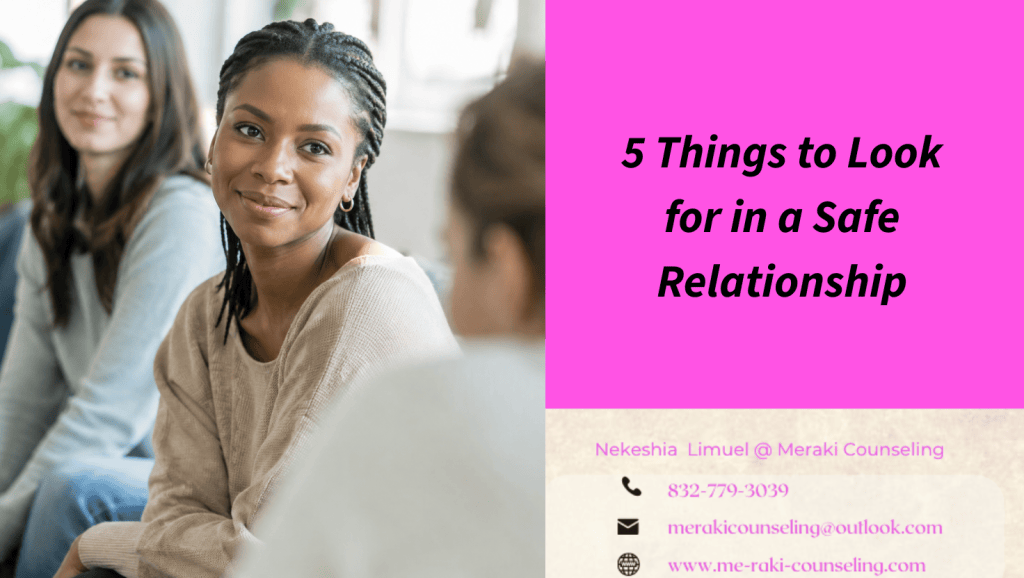
5 Things to Look for in a Safe Relationship

Have you ever opened up to someone only to regret giving them access to your personal life? I have! Lately, I’ve been thinking about the importance of creating safe spaces for those I interact with, both professionally and personally. I’ve learned that just because someone is familiar doesn’t mean they are safe. Safety is foundational to building trust, intimacy, and meaningful connections.

Now, what makes you feel safe in a relationship may look totally different from what makes me feel safe. However, I believe there are certain qualities that should be present before we allow others access to our personal lives. I want to share five things to look for in a relationship that should serve as the currency of trust before we open up to others.

1. Respects Boundaries

I think that so many people operate in relationships without having clear boundaries. Some may even struggle with setting boundaries with people they love, let alone people they are just meeting.

I dealt with a situation where I was called mean because I didn’t allow a person that I share a lot of DNA with to know where I stayed due to her being in a toxic relationship where police were often called out.

Well, a person can call me whatever they want, but I have the belief that your home is your sanctuary. Eventually, they came around to the fact that in order to deal with me, they had to respect my boundaries in the same way that I respect and HONOR the rules you put in place for interactions.

2. Takes Accountability

Have you ever dealt with anyone who does not own the impact their actions had on you? It shows maturity to be able to take RESPONSIBILITY and apologize for the impact it had on another person.

The person who takes accountability by acknowledging their wrongs and/or mistakes is showing that they are able to have empathy towards others. Steer clear of a person who never owns up to the way their actions have affected you.

3. Offers Grace and Safety

I often say, “Everybody has a past.” This statement is rooted in my belief that no one is able to judge another person.

In order to feel safe around others, one has to feel like they are not being judged for what they have done or are currently doing.

As a counselor, I have seen so many people confide in me, not just because I am ethically and legally bound to hold their confidence, but because they feel secure that I have curated a “no judgment” environment.

The same MERCY that I want God and others to show me, I am intentional about showing others, both professionally and personally.

4. Shows Consistency

A couple of concepts that I have learned from my mentor and coach, Dr. Dharius Daniels, are the “currency of trust” and to “examine their fruit” with others you allow to have access to you.

Oftentimes, we set ourselves up for failure when we automatically open up to others without them building that trust or interact based on potential.

Trust has to be earned, and each interaction should be a deposit towards trust and not a withdrawal.

The second concept is not about judging but acting objectively by paying attention to a person’s ACTIONS OVER TIME.

5. Encourages Growth

In order to feel safe in a relationship, you should have the space to grow in life. Anyone who wants to keep you in a stunted state or keep the old you from becoming who you’re meant to be is a red flag.

They support and celebrate you learning and moving towards progress, even if that means you are moving away.

They won’t minimize your accomplishments with remarks like “Your little ________” (fill in the blanks with whatever successes).

I belong to a wonderful community called Daniels Den that encourages and celebrates growth. In fact, we hold steadfast to the Kaizen principle, where our mantra is “We grow until we go!”

There is always room for growth and DEVELOPMENT.

Building Your Life Board™

As you think about the people you allow into your life, ask yourself: Are these relationships providing the safety, support, and space I need to grow? Remember, having people around you is not the same as having the right people around you.

If you’re ready to become more intentional about building your community, explore my guided journal, Life Board: A Guided Journal to Reflect on the People Who Anchor, Affirm, and Align You.

You can also contact Nekeshia Limuel, LPC, at Meraki Counseling Services at 832-779-3039 or merakicounseling@outlook.com to learn more about building confidence and community.

Which of these five qualities do you value most in your relationships? I’d love to hear your thoughts.
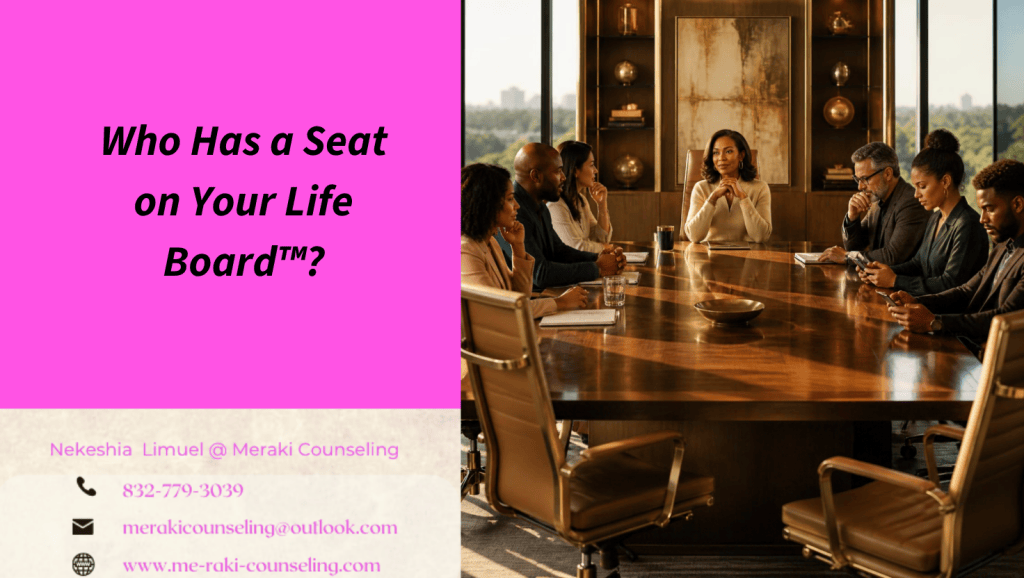
Who Has a Seat on Your Life Board™?

You have people around you, but are they the right people? It’s easy to let life get you wrapped up in the hustle and bustle of things. Before you know it, you have 700 friends on social media and don’t really know 100 of them. True story! Some of us may have even been filling seats just so they won’t be empty.

My mentor and coach, Dr. Dharius Daniels, often says something that is so essential when it comes to relationships: “Access is a privilege, not a right. It’s earned, not owed. Don’t allow people to mismanage their access to you.”

3 Questions to Ask Before Giving Someone Access to Your Life:

Are they aligned with my values? Examine whether their character, priorities, and behaviors support the life you’re intentionally building.

Now that you are well-versed in the seven different members you should have on your Life Board™, it’s time to hone in on the assessment of values. It is true: birds of a feather flock together. I have been able to sit on a dock of the Mississippi River in Louisiana and just observe the wildlife. What I find very interesting is how, if one bird flies in a certain direction, all the others do the same. I know we are not talking about wildlife, but we are talking about human nature. It is quite common to begin to do and say the same things as the persons you spend the most time with.

Is the relationship reciprocal? Consider whether support, encouragement, and effort flow in both directions.

Most people have been in a lopsided relationship at some point in their lives. It doesn’t feel good at all to end up being the person who carries a relationship. Don’t get me wrong; I know that relationships are never really 50/50 or equal parts. The thing is, it is important for people you are in relationships with to have a two-way dynamic. Other relationships, like assignments, may be imbalanced, but vital relationships, like those with Life Board™ members, should be interdependent and mutual in nature.

Does their presence contribute to my growth? Reflect on whether the relationship encourages confidence, accountability, emotional wellness, or joy.

To get to a season in life where you are intentional about growth and notice you have people around you who are nonchalant about seeing you grow is not good. Some people whom I see in the limelight in politics, government, and entertainment, I think, can’t have any friends or people. Living in a world where “yes men” come a dime a dozen, it is important to evaluate if those around you really help to catapult you to the next level and to the next level.

Now, I have a question for you: Who have you given access to your life, and have they earned the privilege of occupying that seat? Remember, having people around you is not the same as having the right people around you. Be intentional about who you allow to sit on your Life Board™ because the people you surround yourself with can influence the direction of your life.

If you need help assessing your relationships or designing your personal Life Board™, don’t hesitate to reach out to Nekeshia c/o Meraki Counseling at 832-779-3039 or merakicounseling@outlook.com.

The Life Board™: A Guided Journal to Reflect on the People Who Anchor, Affirm, and Align You is also available if you prefer a self-guided approach to identifying the people you need to build community and live a flourishing life.

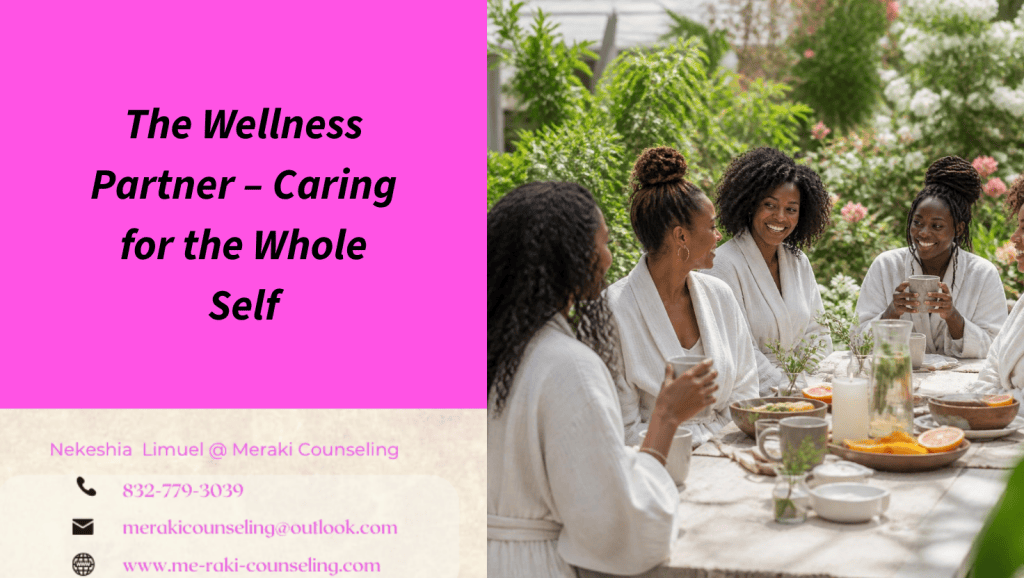
The Wellness Partner – Caring for the Whole Self

Oftentimes, this member, The Wellness Partner, is overlooked when it comes to designing your personal Life Board™ of Directors. It is essential to make sure those around you are living a healthy lifestyle. You may think it is inconsequential, but it is crucial to living a flourishing life. How, do you ask?

Here are 3 ways The Wellness Partner helps you care for the whole self:

1. They encourage healthy habits.

They motivate you to prioritize your physical, mental, emotional, and spiritual well-being through healthy lifestyle choices.

If I am a speaker, but I am binging on sweets and alcohol while speaking across the globe, then I may feel energized at the beginning of the speaking engagement but crash soon thereafter. Or, if the speaker is mentally unwell, those who invited them to the event or even the audience may notice that something is off.

How this person helps you in this area is by encouraging you to increase healthy habits in your lifestyle.

2. They support balance and self-care.

They recognize when you are overwhelmed and encourage you to establish boundaries, rest, and make time for yourself.

Have you ever been around a person who looks tired or becomes irritated easily during neutral situations? More than likely, they lack balance and self-care. This member may help you see that balance is needed to be successful.

A well-rested person is able to make better and wiser decisions. They mention things like having capacity and realizing when you don’t have the capacity to deal with certain situations or family members at certain times.

3. They promote holistic growth.

They hold you accountable for nurturing every aspect of your well-being and encourage you to build a life that is healthy, balanced, and flourishing.

The accountability piece is always a big factor in us achieving our goals in life. If an idea or goal is kept to yourself, you can always hit that snooze button on the clock of success.

This member won’t let you set the alarm for every five minutes until you decide to get up to tackle your goals. They will call you out and challenge you to get up the first time that alarm goes off.

Now, I have a question for you: Who is The Wellness Partner in your life? Who encourages you to take care of yourself, reminds you to rest when necessary, and challenges you to develop healthy habits?

Remember, building a flourishing life requires more than setting goals. It requires surrounding yourself with people who support your overall well-being. Be intentional about who sits on your Life Board™.

If you need help identifying your Wellness Partner or designing your personal Life Board™, don’t hesitate to reach out to Nekeshia c/o Meraki Counseling at 832-779-3039 or merakicounseling@outlook.com.

The Life Board™: A Guided Journal to Reflect on the People Who Anchor, Affirm, and Align You is also available if you prefer a self-guided approach to building your community with intention.

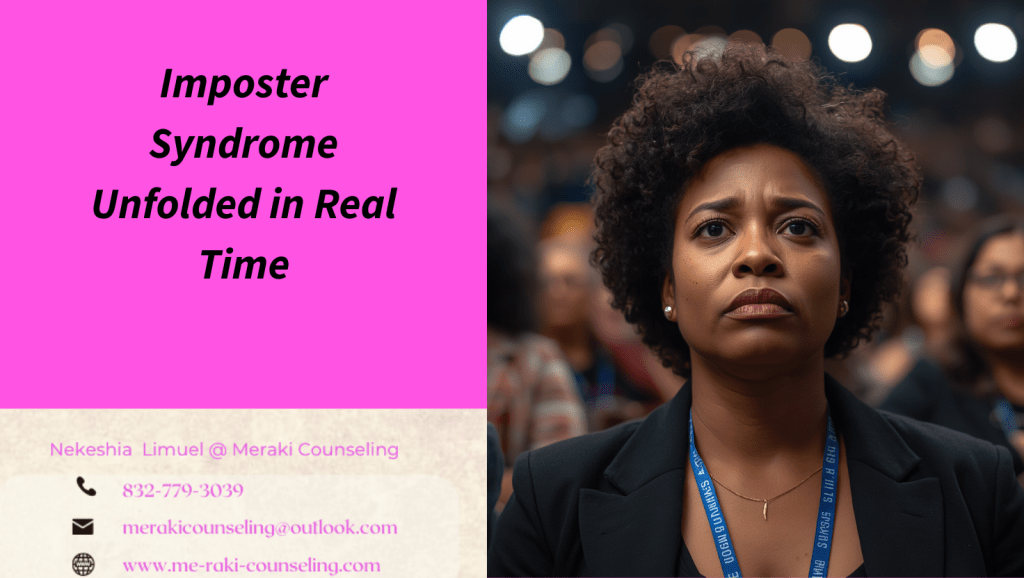
Imposter Syndrome Unfolded in Real Time

As I prepare to embark upon a new adventure as a vendor at a women’s conference, it has become evident how imposter syndrome creeps up behind you.

The perfectionist type has definitely been my shadow for the last few weeks since I signed up to be a vendor. To be candid, I really just thought about attending the event, The Healing Seat, in July. Never did I imagine being a vendor.

I searched Pinterest and YouTube for suggestions for vendors at fairs and trade shows. I even asked ChatGPT to do a mockup image for my table setup. Many trips back and forth to stores and playing with designs on Canva have become a habit for me as I prepare.

I had to stop myself after setting up my table at home, rearranging items on the table, packing everything up, only to bring it back out again to make sure I had the best setup. Not to mention, I broke a glass item that I got from an antique shop in East Texas that is not readily available.

What this experience has taught me is that I, too, suffer with imposter syndrome. The second-guessing and overpreparing were the symptoms that became prevalent while getting ready. I had to take a step back—literally—after stepping on glass that would not have broken if I hadn’t been ruminating over a polished and perfect table that would invite and attract women to my corner.

I had to speak to myself the same way I speak to my clients:

You’ve got this.

You deserve to be in the room.

You were built for this.

This is your calling.

You are talented.

If you have discovered that nasty monster of imposter syndrome lurking in the background, don’t fight it alone. Reach out to Meraki Counseling today for assistance in building your confidence.

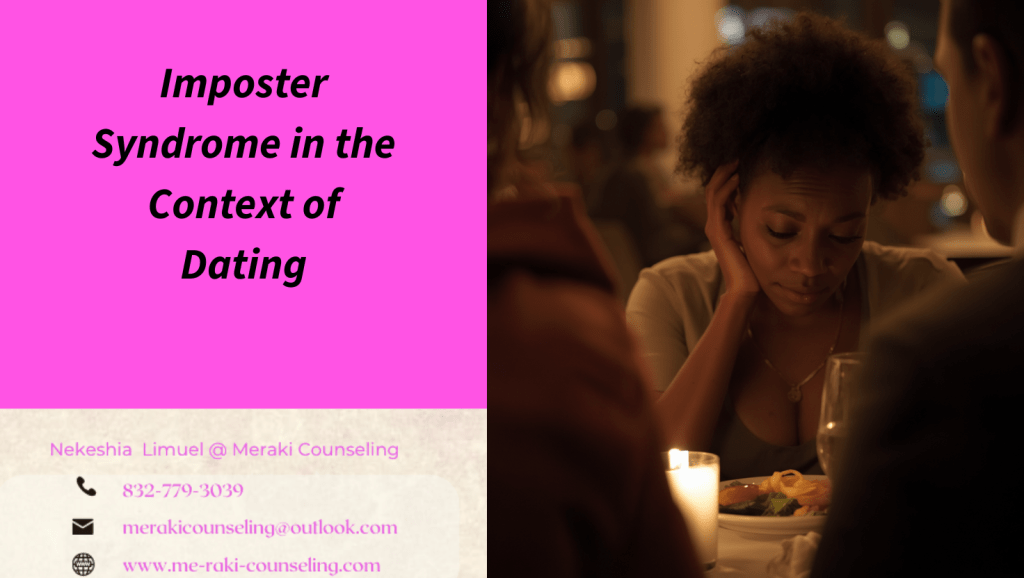
Imposter Syndrome in the Context of Dating

Common Signs

Hyper-focus on flaws: Being able to point out all of your character and physical flaws is common when navigating the dating scene. We definitely don’t want potential mates to find out about our imperfections because they won’t want to deal with us.

Expecting the worst: It is a trick of the mind to brace for potential bad outcomes, especially after kissing so many frogs. Some people have experienced catfishing to the extreme of becoming involved with someone who is living a double life. Now, with the internet, we can see the worst examples from all across the world.

Attributing affection to a quirk: You may feel that someone showing interest in you will eventually lose interest and that their attraction is due to luck or chance. I mean, what would a fine man like that want with a woman like me? You convince yourself that it must be a fluke rather than believing you are genuinely worthy of love and connection.

Why It Happens

Online dating pressures: Apps can pressure you to present a flawless, curated version of yourself, leading to constant comparison and feelings of inadequacy. Now add the layer of AI and photoshopped images, and you can easily hyper-focus on the areas that the opposite sex is typically drawn to.

Past trauma: Trauma trains the brain to stay on alert and anticipate threats. Depending on your experiences, things may have happened that were far outside of what you envisioned for your life. As a result, you may struggle to trust yourself.

Insecure attachment: Depending on your childhood experiences and the people who cared for you during your formative years, certain patterns can develop and carry into adulthood. Anxious and avoidant attachment styles frequently correlate with feelings of unworthiness.

Does any of the above resonate with you when it comes to dating?

If you answered yes, then you may benefit from talking with an objective professional who can help you navigate the murky waters of dating.

Contact Nekeshia Limuel at Meraki Counseling today to begin uncovering the layers of dating with imposter syndrome.

📞 832-779-3039
📧 merakicounseling@outlook.com

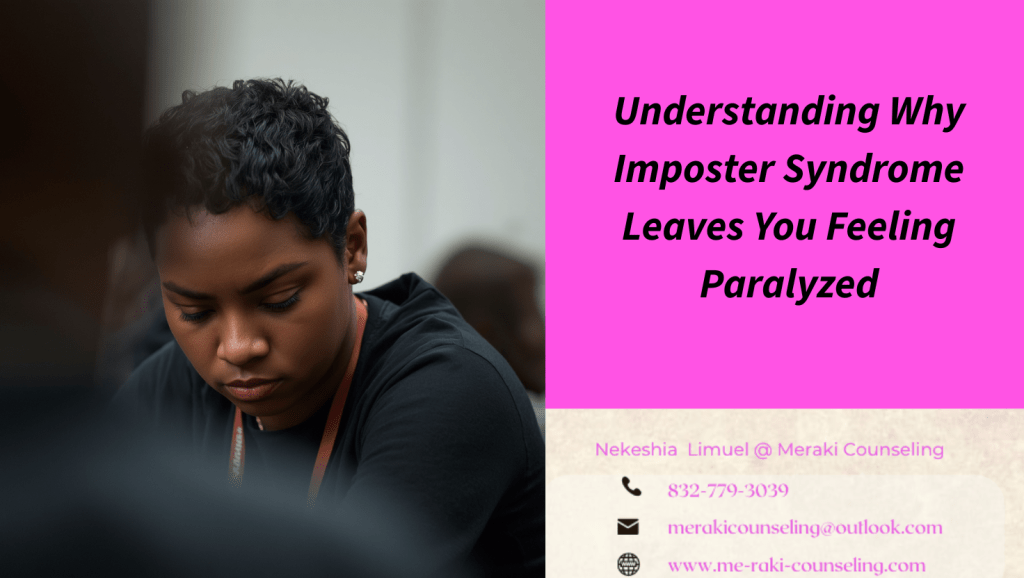
Understanding Why Imposter Syndrome Leaves You Feeling Paralyzed

Have you ever wondered why you feel stuck or paralyzed while dealing with Imposter Syndrome? If you have been following this page for a while, you probably have seen yourself throughout the posts.

Something that I have seen in the lives of so many of my clients is being paralyzed, which keeps them from achieving their goals and living a life that is flourishing. Heck, I’ve even seen this in myself over decades. I started working with a coach, Shalonda Allison, who helped me realize something. The concept that Coach Shalonda revealed to me was the perfect procrastinator. Let me tell you how it shows up in high achievers, specifically myself.

I have a pattern of starting projects but not executing. Why, you may ask? The answer is simple and plain. Something deep inside of me says, “It’s not ready yet. It needs a few more tweaks.” Or I may tell myself, when it comes to building my social life and circle, “I’m not ready to be in a relationship.” This would lead to discounting the hours of education, training, and life experiences I have from 50 years of living.

The truth is I am, and every project I have started is ready to go, but I believe the voices of Imposter Syndrome over being prepared to launch and go. After becoming aware of my patterns through coaching, I made a commitment to myself that I would not start “nan” other project without executing and finishing the plethora of projects living rent-free in my space. Mind you, I have decades of notes in composition notebooks, outlines and book covers for books, and AI chats of formats for groups and programs that would increase and diversify my income.

I have also committed socially to engage with others in an intentional way. No more sitting on my couch watching Netflix when I have been invited to get out and socialize. I even took this commitment a step further by not waiting on anyone to invite me out to socialize. I will create opportunities to realize my goals.

I share my story in an effort for you to see what imposter syndrome looks like in real time. I am a work in progress, and I will continue to do the work so I can be the best counselor and coach delivering services to you. I pray that this article blesses you and helps you realize you do not have to journey alone on this road of self-discovery and overcoming Imposter Syndrome.

Contact me, Nekeshia c/o Meraki Counseling, today at 832-779-3039 or merakicounseling@outlook.com. A thriving life awaits you.