Author Archives: Nekeshia Limuel

What to Get the Woman Who Does Everything (But Doubts Herself)

She’s the one who holds everyone together. You know the strong one…
She shows up early, stays late, and still wonders, “Am I really doing enough?”

She’s the friend who celebrates your wins—even when she’s secretly wrestling with her own imposter thoughts.
The one with the to-do list, the high expectations, and the voice in her head that whispers she’s somehow still falling short.

This year, give her more than just a gift.
Give her permission to do things imperfectly and still feel accomplished. To reflect and pause without feeling like she is slacking. To remember who she is beneath the pressure– often self imposed.

Introducing the Self Discovery to Overcome Imposter Syndrome Journal

A guided journal designed for high-achieving, high-functioning women who silently battle self-doubt. Filled with prompts, affirmations, and space to explore the 5 hidden types of imposter syndrome.

Because even the strongest women need space to fall apart, recalibrate, and rise again—with clarity and self-compassion.


🎄 Perfect for…

  • The overworked perfectionist who hasn’t rested in months
  • The woman juggling a business, career, family—and questioning herself at every turn
  • Your sister-friend, daughter, client, or even yourself
  • Anyone entering 2026 craving confidence over burnout

Buy Now! Because she doesn’t need another mug. She needs a mirror that reminds her who she truly is. https://www.amazon.com/dp/B0FNCQW2PQ

Or Call Today! Nekeshia c/o Meraki Counseling is waiting to coach you through overcoming imposter syndrome. 832-770-3039

Are you The Superhuman/Superwoman?

The superhuman/superwoman believes she is not truly competent among her peers. This individual pushes herself to work harder and harder to prove her worth. This overworking can lead to burnout.

Tell-Tale Signs Someone May Be a “Superhuman/Superwoman” Imposter:

  • Taking on excessive responsibilities, believing one must handle everything alone.
  • Constantly working and feeling guilty when not engaged in tasks.
  • Avoiding help due to fear of being seen as a failure.
  • Striving for perfection across various roles, including work and personal life.

There was a song on the R&B charts back in the day by Karen White called “Superwoman” that came to mind while writing this post. A lyric that stood out, “Boy, I am only human…” resonates with me very much. Women are expected to take on so much in life and not take care of ourselves. We say yes, whether at work or at home with our families, when we are already stretched to capacity. I’ve been at home ill and still felt that I should be doing something productive. I have recently had the revelation that I have gone through life proving myself in relationships. I have tried to prove myself at work to point of exhaustion and using up all my PTO.

You don’t have to do it all to be enough—let’s work together to replace pressure with peace. Call Nekeshia c/o Meraki Counseling at 832-779-3039

Self-Discovery to Overcome Imposter Syndrome Journal

Are you tired of feeling like a fraud—despite your accomplishments? Self-Discovery to Overcome Imposter Syndrome is a guided journal and transformational experience designed to help you break free from Imposter Syndrome and step fully into your God-given purpose.

Through self-reflection, values clarification, and powerful mindset shifts, you’ll uncover the internal narratives holding you back. This journey will help you identify your true passions, recognize your unique gifts, and embrace the legacy you’re meant to leave.

By the end, you’ll craft your Personal Calling Statement (PCS)—a clear, purpose-driven declaration of who you are and what you’re here to do.

Walk away with:

  • Confidence rooted in truth, not fear
  • A clear sense of purpose and direction
  • Practical tools to silence self-doubt
  • The courage to live boldly and authentically

You are not a mistake. You were created on purpose, for a unique purpose. Now it’s time to live like it. Purchase Self-Discovery to Overcome Imposter Syndrome to begin your journey today. Click on the link below:

https://www.amazon.com/dp/B0FNCQW2PQ
Are you The Soloist?

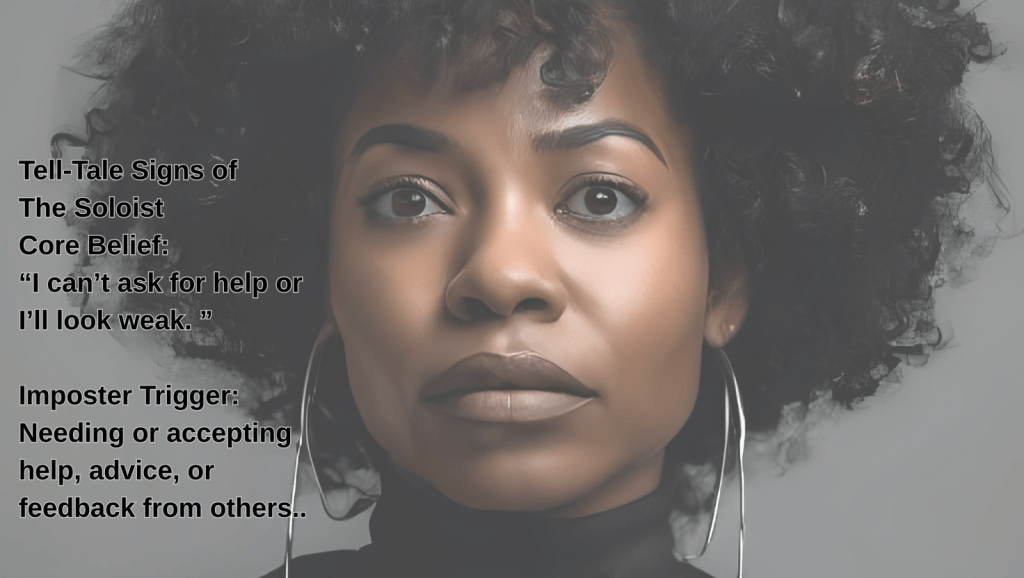
Soloists believe they must handle tasks independently to prove competence, often avoiding help due to perceived weakness.

Tell-Tale Signs Someone May Be a “Soloist” Imposter:

  • Refusing help even when offered
  • Difficulty delegating tasks
  • Preference for solitary work, causing anxiety in collaborative settings
  • Feeling incompetent when needing assistance
  • Overworking, leading to burnout
  • Avoiding mentorship to prevent being “found out”
  • Inability to accept credit for collaborative achievements
  • Emotional and social isolation from working alone

This mindset reminds me of a term that I learned while doing work on myself: hyper-independence. I have experienced this on a familial level. An underlying message is, “Don’t ask nobody for nothing!” I know that is not proper English, but you get the gist. I have gone through life by doing “everything” by myself when I didn’t have to. In the last few years, I learned from my coach/mentor Dr. Darius Daniels, “You can’t be your best self by yourself.” You need a team. You need community. Without the aforementioned, you will not reach your full potential.

Reach out today to begin your journey to counter being a soloist. Nekeshia c/o Meraki Counseling at 832-779-3039

Are you The Natural Genius?

Tell Tale Signs Someone May Be a “Natural Genius” Imposter:

  1. Struggles with anything that doesn’t come effortlessly.
    They internalize difficulty as failure, believing it means they aren’t truly capable.
  2. Gives up quickly when they face a learning curve or challenge.
  3. Avoids trying new things to prevent potential failure or embarrassment.
  4. Feels intense shame if they don’t master something immediately.
  5. Believes effort equals inadequacy.
    “If I were truly smart, I wouldn’t need help.”
  6. Compares themselves to others who appear to succeed with ease, reinforcing a feeling of inadequacy.
  7. May isolate when struggling, feeling like a disappointment or fraud.

I can identify with #2 and #7—the urge to give up when things don’t come easily, and the instinct to isolate when I feel like I’m falling short.

But here’s what I’ve learned:
You don’t have to master everything on the first try.
You don’t have to struggle alone.

If this sounds like your inner story, it’s time to rewrite it with compassion and clarity.
Let’s start uncovering the hidden strengths behind your struggle.

👉 Reach out today to begin your journey out of the shadows of self-doubt. Nekeshia c/o Meraki Counseling at 832-779-3039

Are you The Expert?

Behavioral and Emotional Indicators:

  1. You hesitate to speak up in meetings unless you’re 110% sure of your answer, fearing that any gap in knowledge will expose you as a fraud.
  2. You over-research, over-prepare, and over-certify. You chase degrees, certificates, or courses not out of passion, but from fear that you’re “not qualified enough.”
  3. You rarely apply for jobs, promotions, or leadership roles unless you meet every single requirement—feeling unworthy if you’re missing even one.
  4. You downplay your accomplishments because they were not achieved with “perfect” or “complete” knowledge.
  5. You avoid delegation or collaborative work because you fear being seen as incompetent if you don’t know every detail.
  6. You constantly compare yourself to others in your field who appear to be more knowledgeable—even when you have different strengths.
  7. You feel shame when you don’t know something and see it as a personal failure rather than a normal part of growth.

If The Expert sounds like you, reach out to Nekeshia c/o Meraki Counseling at 832-779-3039 today to find out how to counter these indicators.

Are you the Perfectionist?

The Perfectionist type of imposter syndrome is one of five types, originally framed by Dr. Valerie Young, to be the root of imposter syndrome.

Core Belief: “If it’s not perfect, it’s not good enough—and neither am I.”
Imposter Trigger: You fixate on flaws or mistakes and overlook achievements.
Reframing Statement:
“Excellence allows for growth. I am valuable, even when things aren’t perfect.”

Perfection doesn’t exist. Progress does.

If you’re constantly rewriting, revising, and second-guessing—even when others see excellence—it may be imposter syndrome in disguise. You deserve to move forward without the pressure of flawless performance.

Let’s rewrite that perfectionist narrative together.
Schedule a session today and learn how to give yourself permission to be brilliantly human—not perfect. Call Nekeshia c/o Meraki Counseling at 832-779-3039.

Self-talk and Imposter Syndrome

With Imposter Syndrome the dialogue that one has with themselves is rooted in perfectionism. The inner talk is coated in unrealistic expectations of oneself. Let’s be real, what we tell ourselves comes from a bar that is impossible to reach: “It must be flawless.”

The problem with this line of thinking is that it keeps us stuck. If “I must have every detail figured out” before beginning a project or task, then I will hold off on getting started. Or if the line of thinking is “I’m not fully prepared”, then that will definitely put a hold on initiating one’s quest.

I recall when I tested for my counseling license thinking I wasn’t prepared. I studied and studied some more. The anxiety I felt when scheduling the exam was intense, let alone when I actually took the test. After completing the exam I immediately got my results printed on a sheet of paper. I recall not opening the folded sheet for minutes because I just knew I didn’t pass. When I mustered up the nerve to look at the results I had a big surprise. I exceeded the score needed to become a licensed counselor. I left out a small detail. I graduated from grad school in 2011 and studied up until 2015 when I took the test.

I share my story in order to let you know you are not alone. If you are or have experienced self-talk that impedes your progress, then give me a call. Don’t let imposter syndrome keep you from (taking an exam) living a fulfilling and flourishing life.

Nekeshia Limuel c/o Meraki Counseling at 832-779-3039.

What does Imposter Syndrome Look Like

One tell-tale sign of Imposter Syndrome is over-preparation.
I remember being a new counselor and spending hours writing intake and progress notes. I laugh about it now because, truthfully, each note didn’t—and still doesn’t—require the level of detail I poured into it. It was like writing a dissertation every time I saw a client. After submitting the note, I’d hold my breath, anticipating “imaginary” feedback I believed would be critical, convinced the note was poorly written.

For those of us who struggle with Imposter Syndrome, good is never good enough. And that’s when the endless revisions begin—driven by the belief that we’ve made countless mistakes. This constant self-questioning and doubt about our work keeps us stuck and paralyzed.

If you can relate to over-preparing—even though you have a history of exemplary work—give me a call today. I want to help you move past the mental blocks that arise when you question the quality of your own work.

5 Types of Imposter Syndrome

  1. The Perfectionist: This type sets incredibly high standards for themselves and views any slight imperfection as a personal failure. They may shy away from new opportunities if there’s a chance of making a mistake or not performing perfectly. 
  2. The Superhuman/Superwoman: Believing they are a fraud among truly competent peers, this individual pushes themselves to work harder and harder to prove their worth. This overworking can lead to burnout. 
  3. The Expert: This person feels a constant need to know everything about their field. They may delay starting projects, fearing they don’t know enough, and constantly seek more information to validate their position. 
  4. The Soloist: Soloists believe they must accomplish tasks entirely on their own to prove their competence. They may avoid asking for help, as doing so would feel like a sign of weakness or incompetence. 
  5. The Natural Genius: Individuals in this category equate intelligence and ability with effortlessness. If they have to work hard to achieve something, they see it as a failure or a sign that they are not truly a “genius”. 

Which type or types of imposter syndrome resonate with you?